
The challenge
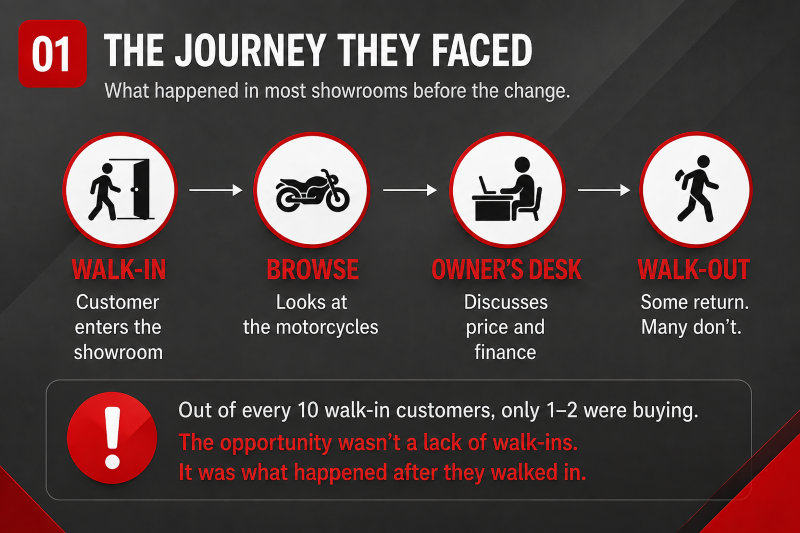
In 2016, a Main Dealer network in one of West Bengal's highest-volume two-wheeler markets was struggling to convert showroom walk-ins into sales.
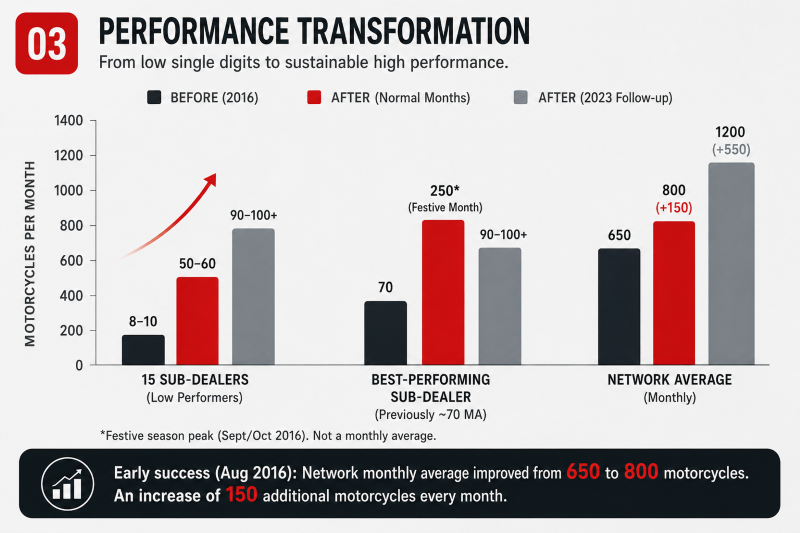
The network comprised 16 sub-dealers. Fifteen of them averaged just 8–10 motorcycles a month. Only one performed consistently well, averaging around 70 motorcycles a month and crossing 100 units just once a year, during the festive season.
Most sub-dealerships were too small to justify a dedicated salesperson, so owners served customers personally while running the rest of the business. Everyone agreed a product demonstration should be part of that conversation. In practice, it rarely was.
Some customers came back. Many didn't. The opportunity was never a shortage of walk-ins — it was what happened, or failed to happen, after they walked in.
The blind spot
The assignment was originally commissioned as a product training programme aimed at improving conversion. During the workshop, participants were asked one question:
"Out of every ten customers who walk into your showroom, how many actually buy your product?"
Workshop facilitator
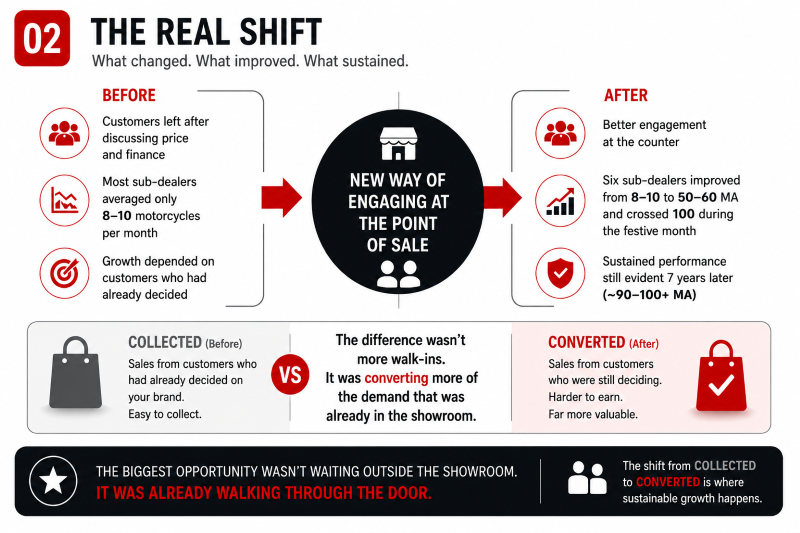
Most answered one or two — roughly 10–20%. The conversation shifted from products to customers. Drawing on their own experience of buying motorcycles before becoming dealers, participants realised something they had never consciously named: not every customer walks in with the same level of brand preference. Some have already decided. Others are still deciding.
They had been serving the already-convinced well, while unknowingly letting undecided customers — the real growth opportunity — walk back out the door.
A practical intervention
Alongside this shift in thinking, the programme introduced a product demonstration approach built specifically for owner-operated sub-dealerships — deliberately simple, easy to learn, and easy to execute consistently at the counter. No complicated sales framework. No dependence on test rides. Just a better way to engage a customer who hasn't yet made up their mind.
The turning point
The network's best-performing sub-dealer, already averaging 70 motorcycles a month, watched the new approach demonstrated and admitted:
"I thought I was already doing the maximum possible. Now I realise there is still room for improvement."
Top-performing sub-dealer
He was told: "You score a century only once a year, during the festive season. Do this consistently in your showroom, and you'll score a century every month. Next festive season, you'll score a double century." He smiled and replied, in Hindi, that the words were sweet to hear — "Aap ke muh mein ghee shakkar."
The results
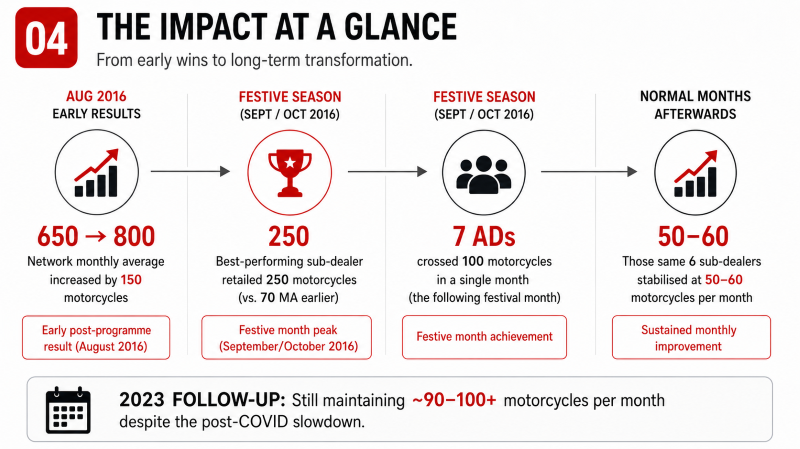
Within months, the impact was measurable. A post-programme review showed the Main Dealer's monthly average retail climbing from 650 to 800 motorcycles — 150 additional units every month, network-wide.
Then came the festive season, and a late-night WhatsApp message.
Sir… retail 250.
The sub-dealer who had once averaged 70 motorcycles a month, and crossed 100 only once a year, had retailed 250 motorcycles in a single festive season. Congratulated the next morning, he said simply, "It's your credit." Asked what had happened to everyone else, his answer was immediate: "They are also doing much better than earlier." A second message soon followed.
Last month 7 AD are cross 100.
Sales managerDuring the festive period, six other sub-dealers — who had previously averaged just 8–10 motorcycles a month — also crossed 100. It wasn't only a festive spike: those same sub-dealers went on to stabilise at approximately 50–60 motorcycles a month, a five- to six-fold improvement over where they started.
Sustained performance
Seven years later, in 2023, a follow-up conversation with the Sales Manager confirmed that — despite the post-COVID slowdown — those same sub-dealers were still consistently delivering approximately 90–100+ motorcycles a month. The improvement hadn't faded after the workshop ended. It had become part of how the network sold.
Proof at a glance
| Before | After |
|---|---|
| 15 of 16 sub-dealers averaging 8–10 motorcycles a month | Six sub-dealers stabilised at 50–60 motorcycles a month |
| Best-performing sub-dealer averaged 70 motorcycles a month | Peak festive retail reached 250 motorcycles |
| Network monthly average: 650 motorcycles | 800 motorcycles — up 150 a month |
| Product demonstrations were inconsistent | A practical demonstration became part of every sale |
| Customers often left after discussing price and finance | Stronger engagement at the point of sale |
| A short-term training intervention | Results still evident 7 years later |
The biggest opportunity wasn't waiting outside the showroom.
It was already walking through the door.
Catalyst — Sales Success, Engineered.