
Evidence
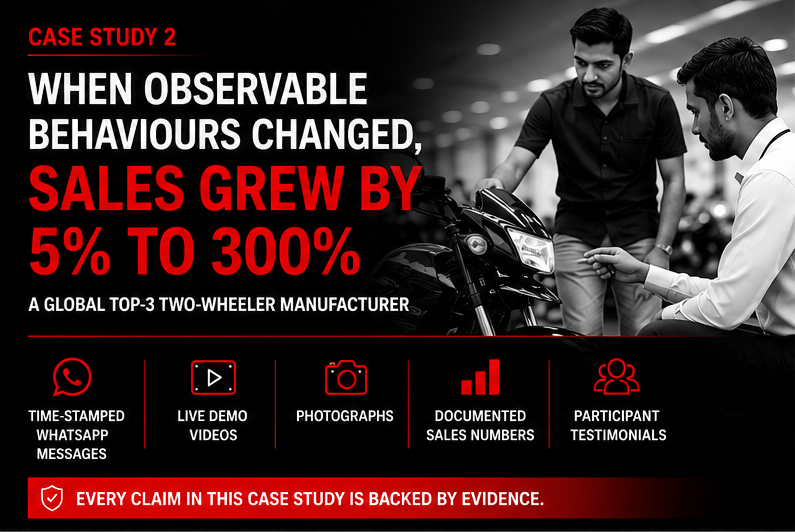
Every claim in this case study is backed by evidence
- Time-stamped WhatsApp messages
- Live showroom demonstration videos
- Participant testimonials
- Photographs
- Documented dealer sales numbers
This is not a retrospective success story. It is a documented record of observable behaviour change, captured as it unfolded on the showroom floor.
The challenge
For years, one objection surfaced repeatedly across rural and semi-urban dealerships:
"Sir… these sales techniques are good. But our customers are different."
A recurring objection, rural & semi-urban dealers
It wasn't a lack of effort. It wasn't a lack of product knowledge. It was a lack of conviction that structured selling could influence customers in their own local market.
One such dealer in Alwar operated almost entirely on his own, without dedicated sales staff — in a highly competitive commuter motorcycle market dominated by the market leader. Customers typically walked in, asked the price, and left. Product demonstrations were brief, feature-oriented, and rarely influenced buying behaviour.
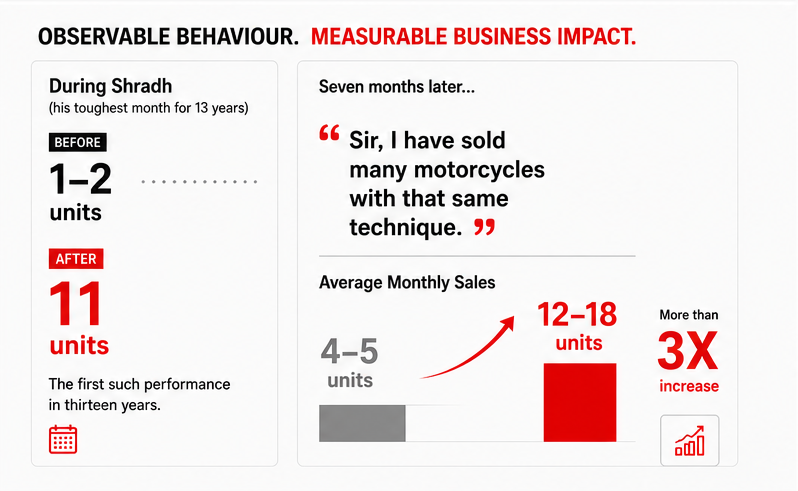
The toughest period every year was Shradh. For 13 consecutive years, the dealership had sold only 1–2 units during this period.
The approach
Instead of teaching more information, the programme focused on something much simpler: making the vital few selling behaviours visible.
The dealer learnt a structured product demonstration built around a handful of observable, customer-facing behaviours. Rather than merely describing product features, he learnt how to demonstrate them in a way that created curiosity, encouraged customer participation, and made product differentiation tangible.
The objective wasn't to improve product knowledge. It was to improve what the customer actually experienced at the counter.
The moment everything changed
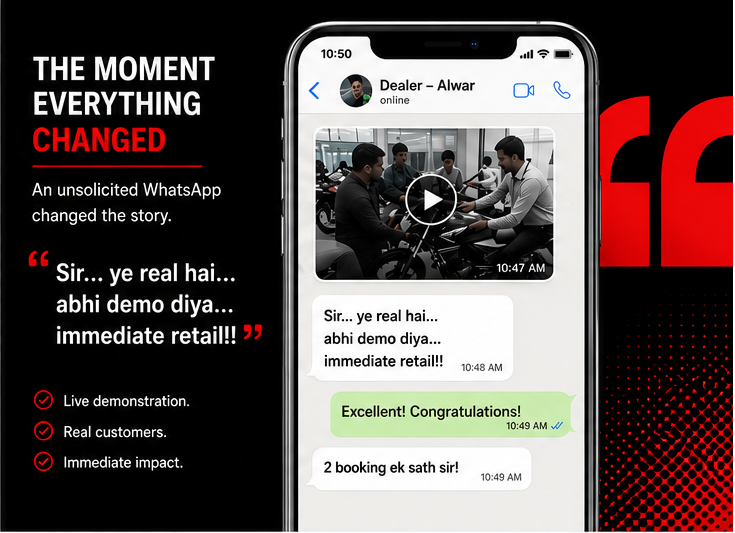
A few days later, an unsolicited WhatsApp message arrived, with a live showroom video attached.
Sir… ye real hai… abhi demo diya… immediate retail!!
Dealer, AlwarThe video captured a real customer interaction. As the dealer demonstrated a seemingly ordinary entry-level product feature using the newly learnt technique,, the customer physically bent down to inspect the product more closely. While the demonstration was still in progress, a second prospect walked into the showroom — and rather than interrupting or asking for the price, he stopped, watched, and stayed engaged. Both customers booked on the same day.
The messages kept coming: more videos, more photographs, more examples of immediate retail after live demonstrations. At first, this read as the enthusiasm of someone new to selling. Then another message arrived.
13 saal ho gaye sir… Shraddh mein only 1–2 gadi hoti thi… 1st time aisa hua.
Dealer, AlwarThis wasn't a newcomer celebrating his first few sales. It was someone who had spent 13 years in the business, experiencing — perhaps for the first time — the immediate commercial impact of a structured product demonstration.
Observable behaviour, measurable impact
The behavioural change translated into business results almost immediately. During Shradh — historically the dealership's weakest selling period — sales rose from the usual 1–2 units to 11 units: the first such performance in thirteen years.
Seven months later, a follow-up conversation confirmed the change had held:
"Sir, I have sold many motorcycles with that same technique."
Dealer, Alwar — seven months on
His average monthly sales had increased from approximately 4–5 units to 12–18 units — more than three times his earlier performance. The behaviour hadn't faded. It had become his new way of selling.
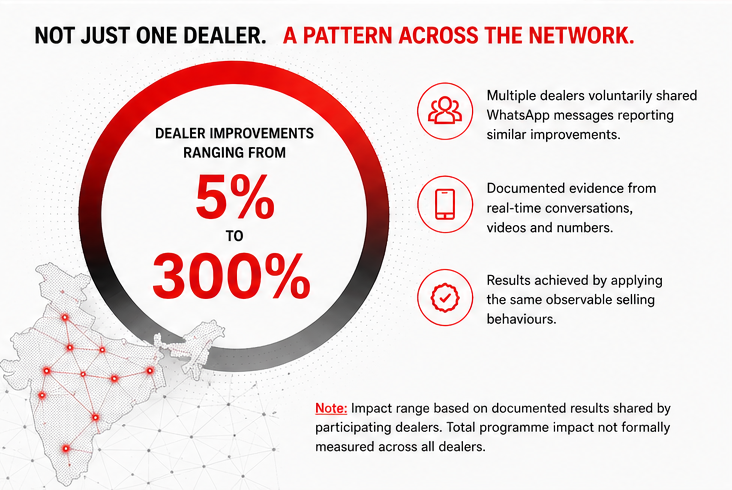
The Alwar story was not unique. Other dealers who had attended similar programmes voluntarily shared WhatsApp messages reporting documented improvements ranging from 5% to 300% after adopting the same observable selling behaviours.
These documented results represent participants who proactively shared their outcomes. No formal census of all adopters was conducted, so the total impact across the network is unknown.
Evidence, not anecdotes
Many business case studies rely on interviews, opinions, or retrospective success stories. This one is different. The evidence consists of time-stamped WhatsApp messages, participant testimonials, photographs, live demonstration videos, and documented sales numbers shared by dealers as the changes occurred.
The Alwar story is not a reconstruction of events months later. It is a documented record of observable behaviour change, captured in real time on the showroom floor. The numbers were not estimated. The videos were not recreated. The excitement was not scripted — the evidence was voluntarily shared by dealers who wanted to show what they had just experienced .
What this proves
| What stayed the same | What changed |
|---|---|
| The market | The salesperson's behaviour |
| The season | What the customer experienced at the counter |
| Headcount | Customer engagement and participation |
| Advertising spend | Sales — by 5% to 300% |
| The product | Conviction that structured selling works locally |
| The customer | A 13-year Shradh sales record |
Results tell you what happened.
Behaviours tell you what made it happen.
When frontline execution becomes visible, coachable and repeatable, performance becomes scalable.
Catalyst — Sales Success, Engineered.