The Productivity blind spot
Every organisation wants new salespeople to become productive quickly.
Most have already invested in:
Knowledge has never been easier to distribute. Yet new recruits often take weeks — or even months — to become consistently productive.
Because knowing… and doing… are not the same thing. Knowledge can be distributed digitally. Execution must be engineered. Performance can then be scaled.
The productivity experiment
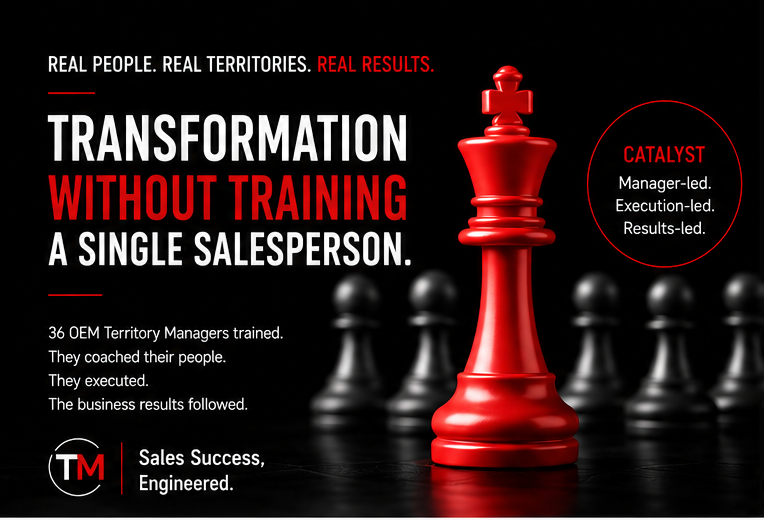
Catalyst wasn't asked to train salespeople. Instead, we trained 36 OEM Territory Managers — the people responsible for improving dealer performance across their territories.
- Not Dealer Sales Executives
- Not frontline salespeople
- Not dealership staff
They were equipped with:
Then Catalyst stepped away. The Territory Managers returned to their dealerships. They coached Dealer Owners. They trained Dealer Sales Executives. They reinforced the execution system with their own teams.
Not a single salesperson in the following evidence was trained directly by Catalyst.
Evidence across the network
This wasn't one successful dealership. It wasn't one exceptional manager. It wasn't one great trainer. The evidence came from four independent levels of the sales ecosystem.
Evidence 01
OEM Territory Manager — Faridabad Territory
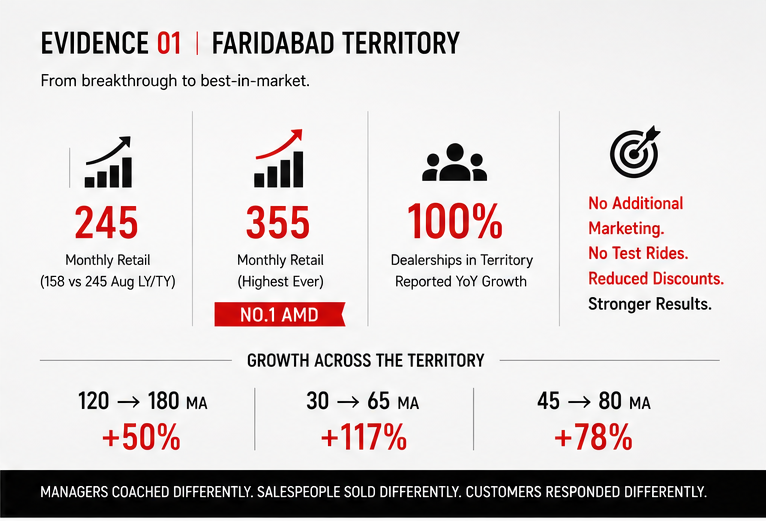
Following the manager-led rollout, the main dealership's retail increased to 245 monthly units — its highest performance up to that point. Months later, the same Territory Manager shared another update: the dealership had reached 355 monthly retail units — its highest-ever monthly retail (Main Dealership + Authorised Dealers combined) — and had become the No.1 Authorised Main Dealer (AMD) in the region.
The momentum wasn't limited to one dealership. Across the same territory, other dealerships also reported substantial improvements:
Most remarkably, these improvements were achieved:
- Without additional marketing campaigns
- Without test-ride campaigns
- With reduced dependence on discounts
Evidence 02
Dealer Owner
The dealer owner wasn't evaluating a training programme. He was evaluating business performance. His verdict was simple:
"Transformation was good & we got real good results. Firstly, discounts were less. Numbers went really high… trust me, numbers went really high."
Dealer Owner
This wasn't feedback about training. It was feedback about business performance.
Evidence 03
OEM Territory Manager — Agra Territory
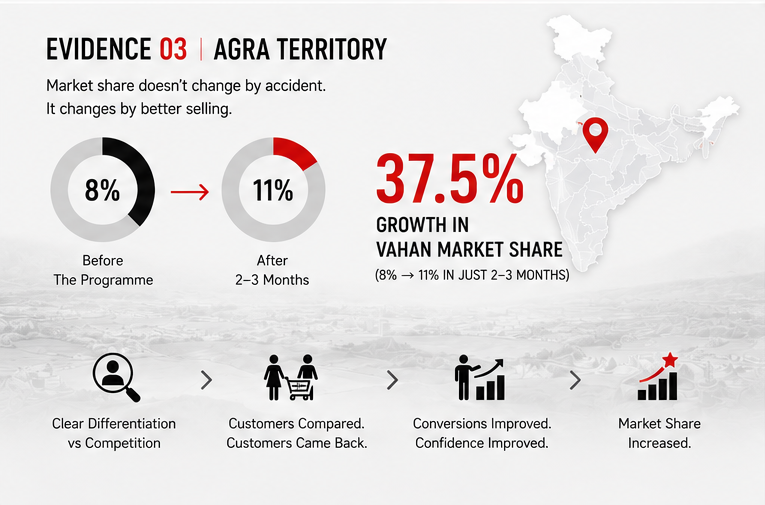
Months later, in an entirely different territory, another Territory Manager independently shared what happened after implementing the same manager-led execution system: VAHAN market share moved from 8% before the programme to 11% within just 2–3 months — a 37.5% growth in VAHAN market share.
Even more importantly, he explained why. Salespeople knew exactly how to differentiate their products. Customers compared competing brands — and came back. Behaviour changed first. Business results followed.
Evidence 04
Area Manager — Sub-Dealer Validation
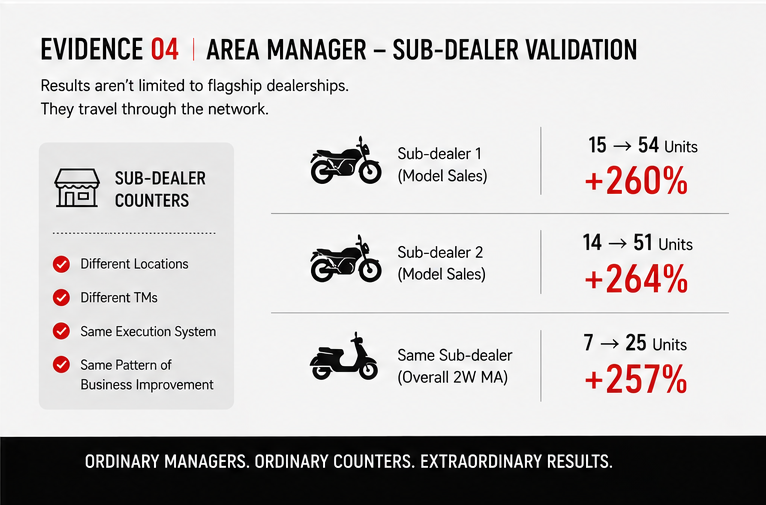
The evidence extended beyond the main dealerships. An Area Manager — responsible for multiple Territory Managers — was asked to identify Authorised Dealers/sub-dealer counters that had delivered exceptional improvements following the manager-led activation programme. He immediately shared examples from two different sub-dealer counters.
These weren't flagship dealerships. They were sub-dealer counters. Different locations. Different Territory Managers. Same execution system. same pattern of business improvement.
Original WhatsApp communication retained as documentary evidence.
What the evidence reveals
The evidence came from every level of the sales ecosystem — the Dealer Owner, an OEM Territory Manager in Faridabad, an OEM Territory Manager in Agra, and an Area Manager overseeing multiple Territory Managers and sub-dealer counters. Different people. Different responsibilities. Different territories. One conclusion.
- Nobody reported more marketing
- Nobody reported larger advertising budgets
- Nobody reported bigger discounts
Instead:
The most important result
It wasn't the sales growth. It was this:
"Catalyst never trained a single salesperson."
Every behavioural improvement happened through OEM Territory Managers and Dealer Owners. They became the coaches. They developed their own people. They reinforced the execution system. They sustained the improvements. The organisation became capable of improving itself.
That is the difference between training people… and engineering execution.
Why this matters
Traditional sales enablement asks: "How do we train thousands of salespeople?"
Catalyst asks a fundamentally different question: "How do we enable thousands of managers to make thousands of new salespeople productive?"
That is the shortest path between recruitment and productivity.
- No dependence on hero trainers
- No dependence on geography
- No dependence on repeated classroom interventions
Just managers equipped with a simple, repeatable execution system that helps new salespeople become productive faster — and enables experienced salespeople to perform more consistently across the network.
The verdict
This is not a story about one successful dealership. It is proof that an engineered sales execution system can be transferred to ordinary managers — who can then reproduce extraordinary business outcomes across main dealerships, sub-dealer counters, territories, and over time.
When independent stakeholders — with different responsibilities and no reason to tell the same story — consistently describe the same behavioural changes and the same business outcomes, it stops looking like a testimonial. It becomes evidence.
The true measure of a sales system isn't whether its creator can produce extraordinary results.
It's whether ordinary managers can reproduce them — at scale.
Catalyst — Sales Success, Engineered.™